The Algorithmic Self
7MINMAY 26, 2026
[ FROM THE NOTEBOOK ]
how AI is reshaping human identity, introspection, and agency
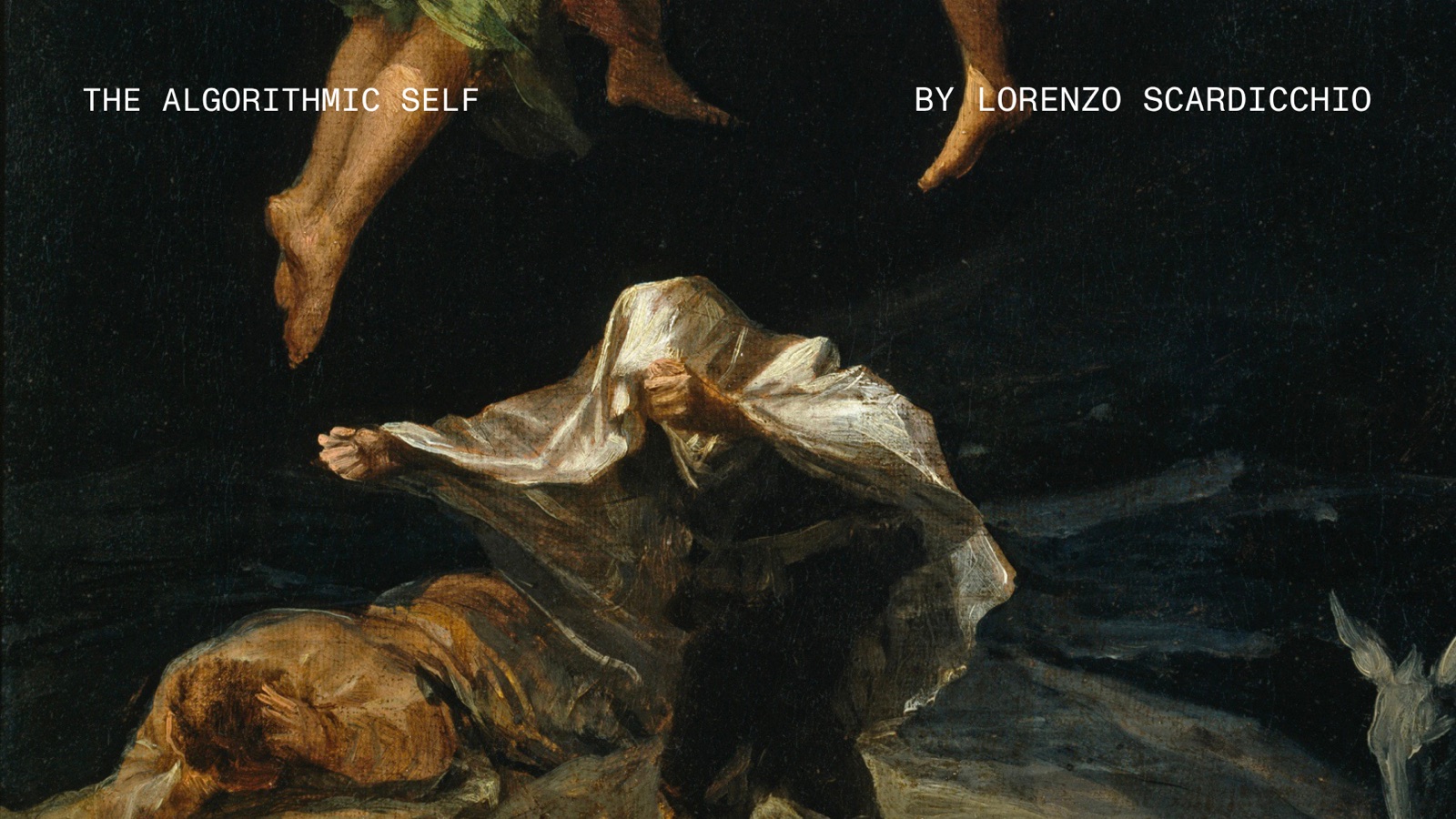 fig 14.1—THE ALGORITHMIC SELF
Dear reader,
I’m sitting at Pandos, the coffee shop down the street, with my partner Becca. We’re writing side by side, looking out at the street: trees, concrete, a bright flower or two doing the heavy lifting of making the whole picture feel alive.
Earlier today I caught myself doing a small, semi embarrassing thing.
I woke up, felt a little tired, and reached for my phone and opened the Oura ring app to find out how tired I was. The number told me what I had already noticed: short night, slightly elevated temperature, low readiness.
Becca watched me do a version of this a few months back and said something that has been sitting in me since:
“The body is the primary source. The ring is the interpreter. Both have value, but don’t outsource the awareness to the device.”
The more I pay attention, the more I notice how many of my awarenesses are getting handed back to me, pre-chewed, by something that didn’t have them first.
We used to figure ourselves out through life.
Friends. Family. Journals. Therapy. Long walks. Bad dates. Good books. Crying in the shower like a respectable adult.
Now Spotify tells me what kind of music I like. TikTok tells me what I’m into. A smartwatch tells me how my body is doing. A chatbot tells me how I feel. A feed tells me what matters. Predictive text finishes my sentences before I’ve decided what I think.
I’m calling this the Algorithmic Self, a version of identity shaped by constant feedback from AI systems. Not just reflected by technology. Co-created by it.
The mirror became a mold
Algorithms used to sit behind the screen. Now they actively participate.
I notice it most in the small moments. The way I look at my Spotify Wrapped at the end of the year and feel a quiet yes, that’s who I am, as if a marketing recap had become a personality test with better branding.
Cute? Sure. Harmless? I’m not so sure about that.
Because once the machine starts saying here’s who you are, a lot of us start nodding.
The danger of outsourcing your inner life
A few weeks ago I sat across from the president of a major university and asked him, directly:
“What do you think we should be working on?”
I caught the shape of it as soon as it left my mouth. That is the absolute shadow version of the right question.
Any wise mentor would have flipped it back: well, what do you care about?
Only I have that answer. But I outsourced it. To an advisor with a hefty title. Because somewhere along the way I’d gotten more practiced at asking than at knowing.
Help me think is one thing. Think for me is another.
When we outsource too much reflection to anything, whether it’s a mentor, an app, or a model, we start trusting the interpretation more than the feeling. The result isn’t just less introspection. It’s a thinner relationship with the self.
Or, said less politely: your app should not know you better than you know you.
Personalization is a velvet cage
There’s a metaphor I keep using lately, half-joking and half not: the rat in the maze.
You teach a rat where the cheese is. The rat finds the cheese. The rat keeps going back to the same place. Move the cheese, and the rat still returns to where the cheese used to be. It stops seeing the edges of the maze. The route eats the curiosity.
That’s what predictive personalization does to me on a long day.
I click introvert content, so it gives me more introvert content. I watch one anxious-productivity video at 11pm, and suddenly my whole feed becomes anxious-productivity. The algorithm keeps feeding me back a version of the self I had yesterday, and slowly today’s version gets thinner.
Soon I’m not choosing. I’m consenting to a menu the machine already narrowed for me. The illusion of choice. The cheese where the cheese used to be.
The quantified self becomes a tiny little prison
Back to the Oura. Sleep score. Step count. Mood rating. Productivity metric. Focus score. Readiness score.
Numbers are useful until they become a personality.
I have watched myself, more than once, wake up, see a 64 readiness score, and decide the day is ruined before I have tasted coffee. The number became more trusted than the body.
Becca’s line again: the ring is the interpreter, not the source.
My body said you slept short, you’re a little dehydrated, drink water.
The ring said you are a 64 today.
I metabolized these as information from a “truthful” source.
That’s the trap. The data says you are tired, so you become tired.
AI as co-author of your life story
I make sense of my life by telling it to myself, to Becca, to a notebook, to a few close friends.
But now Instagram memories, Spotify Wrapped, fitness milestones, photo recaps, and AI summaries are quietly packaging my year into clean little highlight reels. The shiny parts. The optimized parts. The parts that fit.
Life is not clean.
Growth is messy. Contradictory. Awkward. Weird. Full of bad decisions and half-finished thoughts and strange Friday night at a concert that somehow changed everything.
The algorithmically edited version of my year flattens that. It captures the shiny. It misses the contradiction.
And contradiction, I’ve come to believe, is where most of the meaning lives.
The shadow side of self-knowledge
There’s a thing I’ve started calling the shadow of self-knowledge, and it isn’t AI’s fault. It’s mine.
I read the book. I take the assessment. I learn my human design type. I do the breathwork. I file the insight away. Then I move on.
Forward motion. Felt productive. Felt like growth.
But forward motion isn’t the same as digestion.
You can put in all the reps of building a knowledge base of self and never actually allow time and space to sit with it. It’s very easy to let self-awareness become another productivity loop. At least it’s felt that way for me.
AI just makes this cheaper and faster. You can have ten frameworks by lunchtime. None of them have legs.
The way out is not anti-machine
I don’t think the answer is throwing my phone into a lake, although it is tempting.
The answer is agency. Algorithmic literacy. Noticing how systems shape my perception, my preferences, my mood, my sense of myself, and treating each nudge as an invitation instead of a verdict.
Becca described what an honest tool does after I left a dish on the counter and she pinged me about it without making me feel bad:
“It reminded me without making me feel like I was bad for having forgotten.”
That’s the bar.
It points. It doesn’t author.
Or, as she said about another product I’m working on:
“It’s an interface between you and you.”
In my own language, which I keep coming back to:
Knowledge + Embodiment + Repetition = an authentic life.
Knowledge alone becomes intellectualization. Knowledge plus embodiment without repetition becomes a one-off insight that fades.
The whole point is to slow down enough to let what you’ve learned actually land in your body, and then live the same small thing on repeat until it becomes you.
You need to slow down before you can speed up.
The sticky takeaway
AI and these platforms should be a flashlight. Not a mirror. Not a priest. Not a parent. Not the author of your soul with a push notification budget.
The more I let algorithms tell me who I am, the less practice I get becoming myself.
That’s the real game.
Not will AI replace us?
Will I quietly let it convince me to replace my connection with my writing, my work, my reflection practice?
The most powerful moment was a question Becca asked me while we were sitting at our kitchen table:
“Is this the work you actually want to be doing?”
Instead of producing the smart answer I usually produce, I sat with it for a long minute and said:
“I don’t know.”
That sentence is what no algorithm can generate for me.
That sentence was the way back in. It was the invitation I needed to actually sit with that and give it space.
Yours,
Lorenzo